Affiliate disclosure: As an Amazon Associate I earn from qualifying purchases. Learn more
Tucked inside Twin Rivers State Forest in North Florida, the former town of Ellaville sits quietly along the Suwannee River, its sawmill past slowly disappearing beneath decades of forest growth. A hiking trail winds through that same landscape today, passing scattered foundations, old machinery, and remnants of a community that once hummed with lumber activity.
The destination is not a preserved ghost town with standing buildings, but the fragmentary evidence left behind tells a genuinely compelling story about Florida’s 19th-century timber industry. For anyone near Madison County, Lee, or Live Oak looking for an affordable day outdoors, the Ellaville Trail offers history, river scenery, and quiet forest walking all in one outing.
The Trail Reaches Ellaville’s Former Town Site
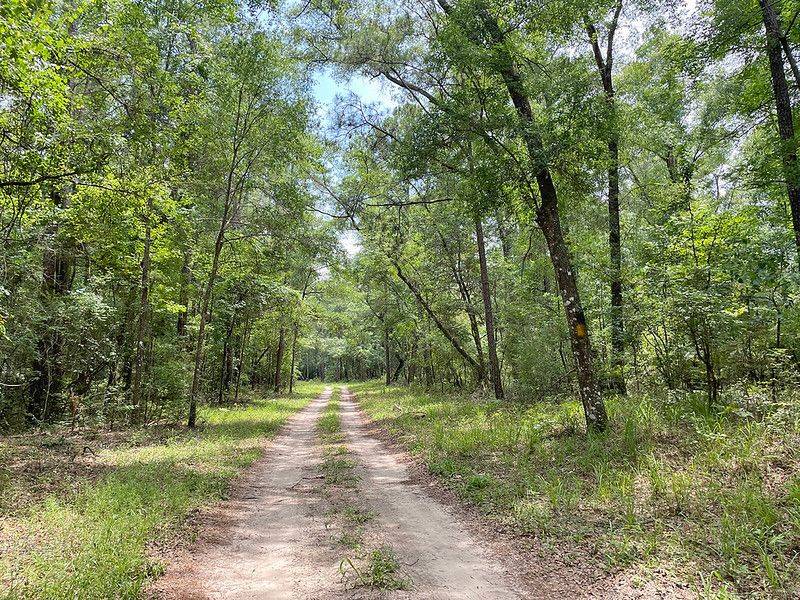
Somewhere along the western bank of the Suwannee River, where the Withlacoochee River flows in from the west to meet it, a hiking trail passes through land that was once a busy North Florida town. The former Ellaville town site sits inside Twin Rivers State Forest’s Ellaville Tract, managed by the Florida Forest Service in Madison County, not far from the small community of Lee and west of Live Oak.
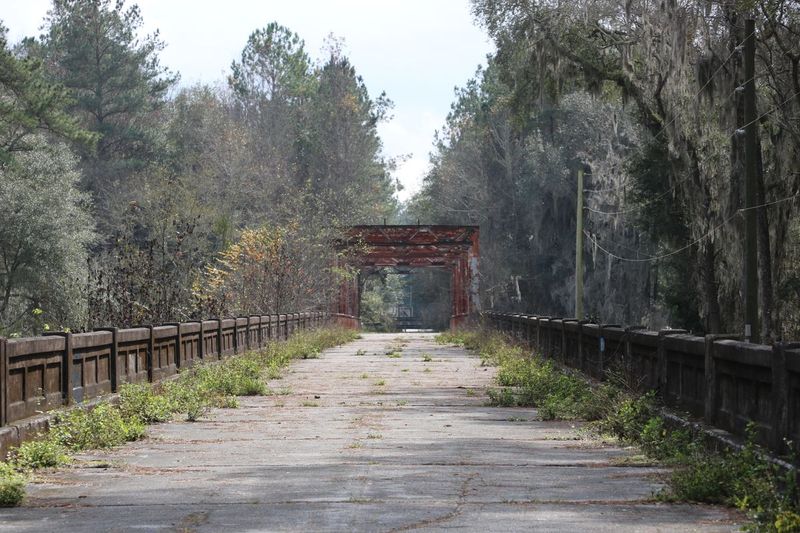
The Ellaville Trail enters the area associated with the former town, running through river-corridor forest and past remnants of what was once a substantial lumber and manufacturing settlement. What the trail does not deliver is an intact ghost town, a preserved row of abandoned buildings, or a single dramatic endpoint where the old community stands frozen in time.
The town is gone in the conventional sense, and the evidence it left behind is scattered and fragmentary.
That distinction matters before you pack your boots and drive out. Florida’s historical marker documentation for Ellaville records the community’s rise and disappearance as a place that declined over decades, not one that was abandoned overnight.
What visitors encounter today are the quiet physical leftovers of that long decline: machinery, foundations, and marker-described ruins set within a working state forest.
Nearby, Suwannee River State Park manages adjacent land and historical features along the same river corridor, so it helps to know which property you are entering. The principal trail and the former town site are accessed through Twin Rivers State Forest.
Understanding that boundary keeps expectations accurate and helps visitors find the right trailhead before they go.
Ellaville Rose Around a Major Sawmill
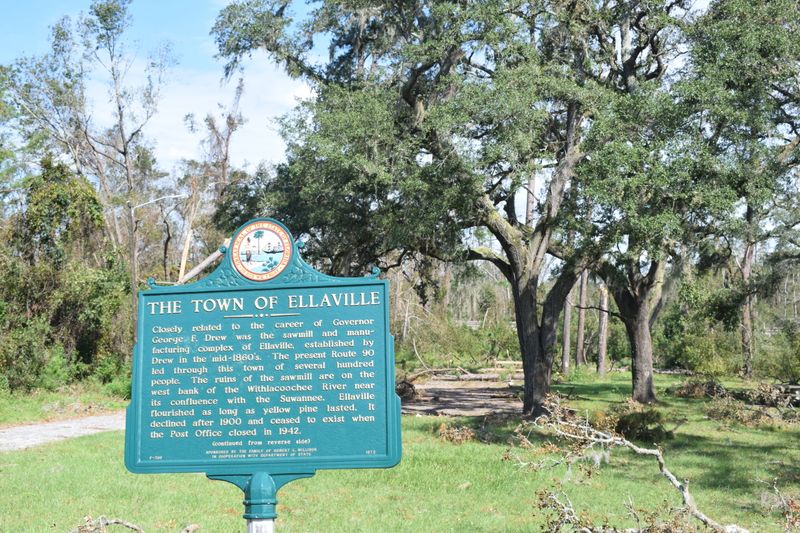
George Franklin Drew arrived in the Suwannee River region in the years following the Civil War and built what Florida’s Department of State identifies as the state’s largest sawmill at Ellaville in 1865. That single industrial operation became the engine for an entire community.
Workers and their families settled nearby, and Ellaville grew into a functioning town with a post office, a store associated with Drew and his business partner Louis Bucki, and the infrastructure that a working lumber town required.
Drew himself went on to become Florida’s governor, serving from 1877 to 1881, but Ellaville predates and outlasts his political career as a place tied to the timber economy rather than to state politics. The town’s fortunes were always bound to the yellow pine forests surrounding it, and that connection eventually became its undoing.
As the surrounding pine stands were cut down and not replanted at a rate that could sustain the mill, the economic reason for Ellaville’s existence weakened. The historical marker record documents the town’s decline following the depletion of the yellow pine, a pattern repeated across North Florida and the broader South as the 19th-century timber industry moved through entire forest regions and left economically hollowed communities behind.
The community did not disappear on a single date. Families drifted away over years as work dried up and services closed.
Florida Memory’s records on Ellaville point to the 1942 post office closure as the clearest administrative marker of the community’s end, but that date reflects the conclusion of a long decline rather than a sudden exodus.
By the time the post office closed, Ellaville had already ceased to function as a town for most practical purposes.
The Surviving Evidence Comes in Fragments
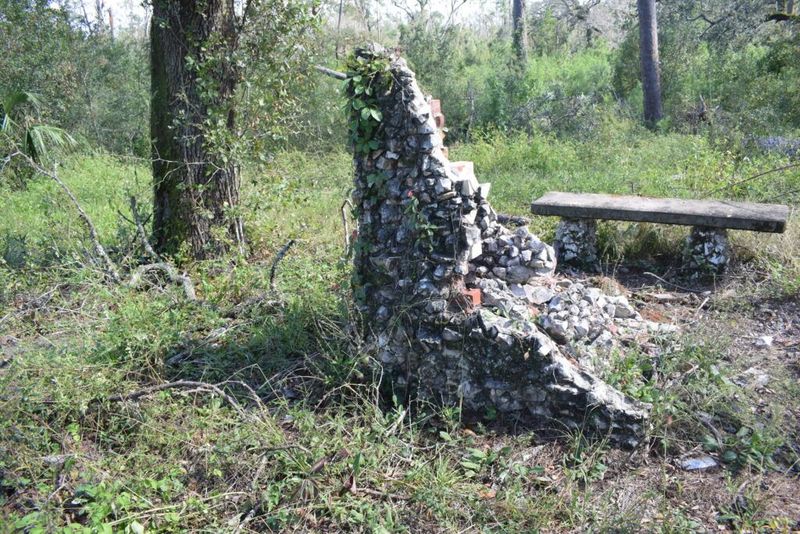
Standing at the former Ellaville town site today, a visitor’s first impression is likely to be forest, not ruins. The trees have reclaimed most of the ground where the community once stood, and the physical evidence that remains requires some patience and attention to notice.
What has survived falls into a few distinct categories, none of which resemble the dramatic streetscapes that the phrase “ghost town” sometimes conjures.
Suwannee River State Park’s historical record identifies sawmill wheel machinery from an 1800s sawmill as one of the tangible remains associated with Drew’s lumber operation. Foundations and marker-described ruins are also present, giving visitors something concrete to locate and photograph.
These are the kinds of remains that reward a slow, observant walk rather than a quick pass through the area.
The Drew Mansion is a separate chapter in Ellaville’s story, and a significant one. The Florida Senate’s historical documentation and related records confirm that the mansion burned in 1970.
What visitors reach today is the mansion site, not an intact abandoned house. Expecting a standing structure and finding a cleared remnant is a common source of disappointment for visitors who arrive without that context.
The atmosphere at the site comes from something subtler than standing walls: the contrast between the industrial scale of what once operated here and the quiet forest that has replaced it. Florida Memory’s documentation of the area underscores how thoroughly the timber economy reshaped this landscape and then withdrew.
One University of Florida educational resource about the Ellaville area notes explicitly that there is no record of a haunting at the site, which is worth knowing before anyone arrives expecting paranormal drama.
The eeriness here is historical, not supernatural.
The Ellaville Trail Follows a Wooded River Corridor
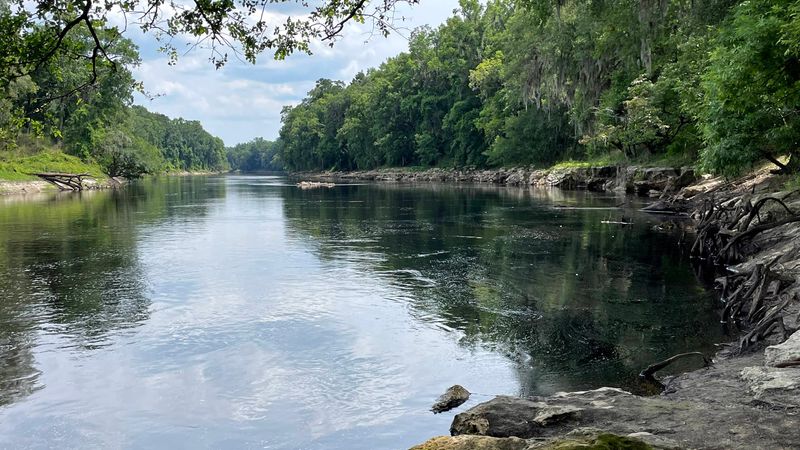
Walking the Ellaville Trail means spending most of your time inside a forest corridor shaped by two rivers. The Ellaville Tract sits near the confluence of the Suwannee and Withlacoochee rivers, and the trail moves through the kind of mixed bottomland and river-bluff habitat that characterizes this part of North Florida: tall trees, sandy stretches, exposed roots, and shifting light from the canopy above.
The Florida Forest Service’s recreation page for Twin Rivers State Forest lists the Ellaville hiking loop at approximately 5 miles, with a 3-mile Trailwalker shortcut available for those who want a shorter outing. However, the Florida Forest Service’s Trailwalker program listing gives the full loop as 5.5 miles.
The discrepancy is small but real, and hikers should download the current georeferenced map from the Florida Forest Service before heading out rather than relying on either number alone.
River views along the trail are possible and worth anticipating, but they are not guaranteed at every point or in every season. Vegetation along the river corridor can block sightlines significantly during warmer months when growth is heaviest.
A local nature account of the Ellaville area notes that some features become easier to see in winter when vegetation thins, though that observation reflects one visit rather than a fixed condition you can count on.
The trail also passes near public river access points to both the Suwannee and Withlacoochee rivers. River level, recent rainfall, and seasonal vegetation all influence what you see from the bank.
Plan for a forest walk with possible river glimpses rather than an open overlook, and the actual experience is likely to feel like a genuine reward rather than a letdown.
Plan Around Multiple Access Points and Changing Conditions
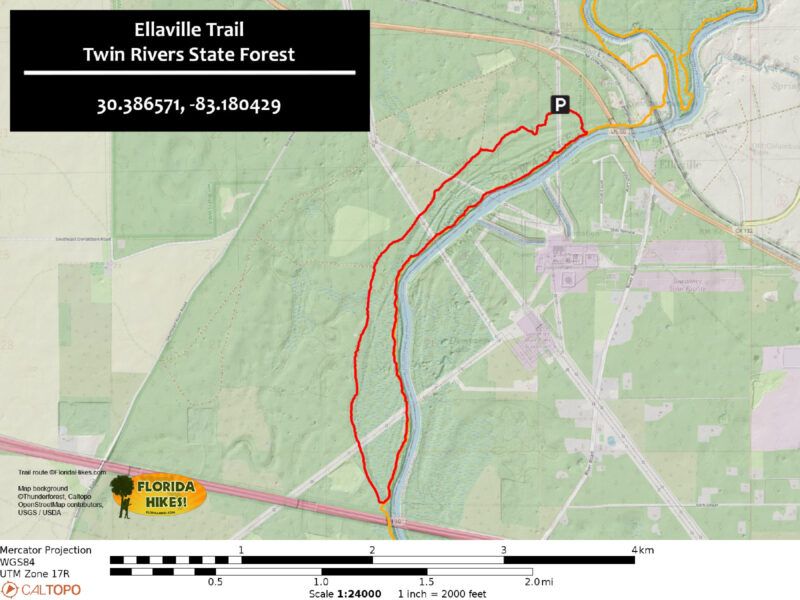
One of the easier mistakes to make when planning this outing is assuming there is a single obvious entrance to the Ellaville Tract. Twin Rivers State Forest contains multiple noncontiguous tracts and several documented access points, and the Ellaville area is no different.
The Florida Forest Service’s recreation page identifies access from a Trailwalker trailhead on U.S. Highway 90, as well as additional entry areas from Myrrh Road, Central Ellaville Avenue or Drew Way, and a southern site near SE River Road.
Each access point may lead to a different segment of the trail or a different part of the tract, so downloading the georeferenced map from the Florida Forest Service before you leave home is a practical step rather than an optional one. The forest’s multiple entry points are a feature for visitors who want flexibility, but they can create confusion for anyone who simply drives to the first road sign they spot.
Twin Rivers State Forest’s main page lists day use from sunrise to sunset and a $2 state-forest day pass, with an annual pass available as an alternative. Those fees and hours are current at the time of writing, but they are subject to change, and confirming them directly with the Florida Forest Service before your visit takes only a moment.
Several tracts within Twin Rivers State Forest are managed as wildlife-management areas where hunting is permitted during designated seasons. Checking current hunt dates and any associated access restrictions before you go is a straightforward precaution that can affect which parts of the forest are open to foot traffic on any given day.
Trail conditions, seasonal closures, and route distances can all shift, so treat any single source of planning information, including this article, as a starting point rather than a final answer.
Visit the River and Ruins With Basic Trail Safety
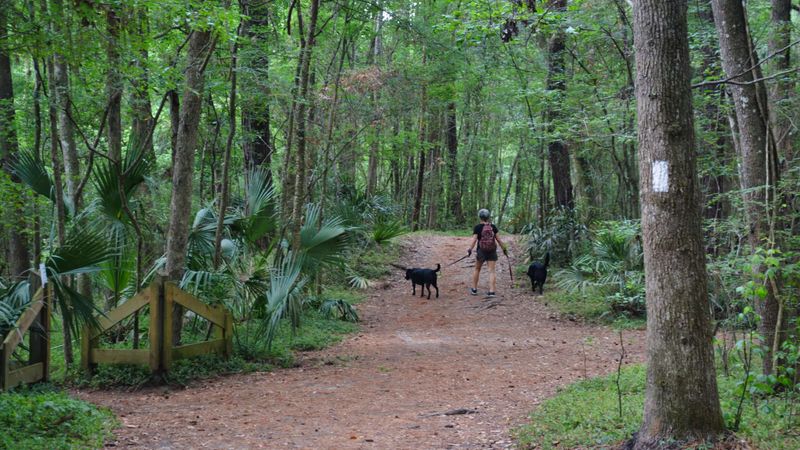
A walk through a North Florida river-corridor forest in any season carries a predictable set of physical challenges. Heat and humidity are significant factors for most of the year, and the trail surface includes sandy stretches, exposed roots, and uneven terrain near the river edge.
Wearing supportive footwear, carrying more water than you think you need, and starting early in the morning during warmer months all make the outing more comfortable and safer.
Twin Rivers State Forest’s wildlife list includes alligators, deer, bobcats, otters, beavers, and wild turkeys, among others. Alligators are a year-round presence near Florida rivers and should be treated with consistent caution.
Florida Fish and Wildlife Conservation Commission guidance is clear: keep a safe distance, never feed alligators, and back away calmly if one approaches. FWC also advises against swimming or wading in areas where alligators are known to be present, which applies to the Suwannee and Withlacoochee river edges throughout this area.
Ticks are a consistent concern in wooded Florida terrain. CDC tick-prevention recommendations include wearing long pants and long sleeves, using an EPA-registered repellent, treating clothing or gear with permethrin where appropriate, and staying on designated trails.
CDC guidance for outdoor workers adds that a thorough check of the body, clothing, gear, and pets after any wooded outing is an important follow-up step, not just a suggestion.
At the ruins themselves, the appropriate behavior is observation and photography. Florida DEP’s land management standards identify trespassing, looting, and physical disturbance as genuine threats to archaeological and historic resources.
Moving bricks, digging, collecting artifacts, climbing unstable structures, or creating new paths off the designated route all cause damage that cannot be undone.
Stay on marked trails, travel only during daylight hours, and leave every physical remnant exactly where you find it.
Ellaville’s Atmosphere Comes From History, Not Hype
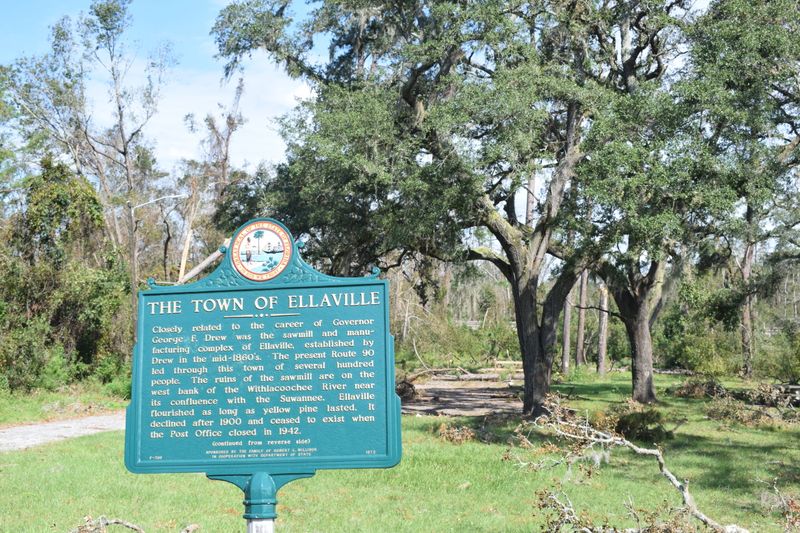
The honest payoff of a visit to Ellaville is not a dramatic ruin field or a cinematic overlook above the Suwannee River. The Ellaville Trail in Twin Rivers State Forest offers a low-cost North Florida forest walk through a river-corridor setting, with fragmentary industrial remains scattered along the way.
The experience asks visitors to do some of the imaginative work themselves, piecing together what a once-productive sawmill town looked like from a rusted wheel, a stone foundation, and a historical marker.
That kind of visit suits a particular type of traveler: someone curious about place and history, comfortable with subtle evidence, and willing to accept that nature has moved back in over the past century. The historical record preserved through Suwannee River State Park and Twin Rivers State Forest together provide enough documented context to make the walk feel grounded rather than speculative.
Before visiting, confirm current trail distances, access points, fees, and any seasonal closures directly with the Florida Forest Service, since conditions change and no single article can substitute for current official information. Leave the historic landscape exactly as you find it, and what Ellaville still has to offer will remain available for the next visitor who comes looking.
The forest has been quietly keeping this history for more than a century; a careful walk through it is the closest most of us will get to the town that once stood here.